Yoga mats
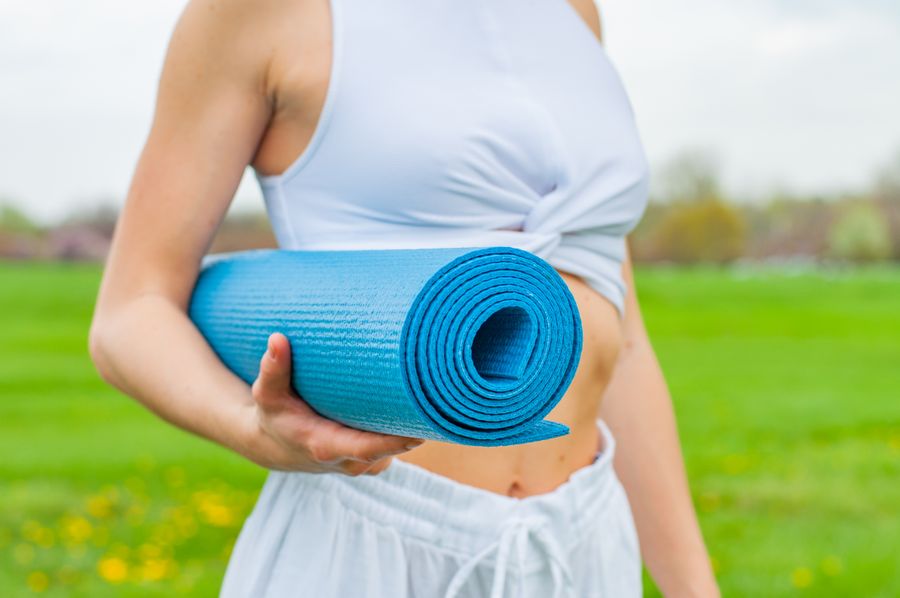
The yoga mat is the one piece of equipment almost every practice uses, so it deserves the most attention. A good mat gives you a stable, comfortable, non-slip surface between you and the floor.
What to consider: thickness, grip, material, weight and how you plan to move it. Thicker mats (around 6 mm and up) add cushioning for sensitive knees but can feel less stable for balance postures. Thinner mats (around 3-4 mm) sit closer to the floor and are easier to roll tightly and carry. Grip matters most when your hands or feet sweat during practice; textured surfaces help here.
Material affects grip, feel and care. PVC mats are common, durable and affordable, while natural-rubber mats offer excellent grip but some people find them heavy or sensitive to their smell. Whether you practise at home or travel with your mat, fold and roll it, and check whether it needs a detachable carry strap.
Beginner tip: you do not need a premium mat to start. A standard 5-6 mm mat with reasonable grip is enough while you find the style of practice you enjoy.
Yoga blocks
Blocks bring the floor closer to you. In standing forward bends, seated folds and many poses, a block lets you rest your hands or hips at a comfortable height, which helps you keep the pose aligned rather than straining to reach the ground.
Blocks come in foam, cork and wood. Foam blocks are light and soft, cork blocks are firmer, denser and stable, and wooden blocks are the heaviest and most rigid. Size matters too: the standard block is roughly 9×6×4 inches (23×15×10 cm), and some people prefer larger blocks for more height. Choose based on the firmness you like and how often you travel with them.
Cheaper blocks can develop dents where your weight rests; for daily use, a firmer block keeps its shape longer.
Yoga straps
A strap extends your reach in poses where your limbs are not long enough to meet. It helps in hamstring stretches, shoulder work and binds, letting you hold the position with control instead of forcing it.
Most straps are cotton or nylon, about 6-8 feet (1.8-2.4 m) long, 1-1.5 inches wide, with a metal or plastic buckle. Check that the buckle holds firmly and the fabric does not fray at the edges. A strap with a D-ring loop is handy - you can make a loop for your foot without fiddling.
Beginner tip: if you feel tight in hamstrings or shoulders, a strap often helps more than pushing harder. It lets you feel the stretch at a controlled level of effort.
Bolsters
Bolsters are firm, cushioning supports - typically rectangular, round or half-moon shaped - used in restorative poses and relaxation. They lift the body gently so you can hold a pose without muscle effort, which makes them excellent for lying forward folds, supported backbends and breathing practice.
Rectangular bolsters give a wide, stable platform, while round bolsters offer a taller lift for opening poses. Look for a dense filling that keeps its shape under sustained weight, a removable, washable cover, and a size that matches your listed dimensions. Bolsters are a comfort-first purchase, so try to match them to how you actually rest in them.
Meditation cushions
Meditation cushions (often called zafus, alone or with a zabuton mat beneath) tilt your pelvis forward so your knees can drop toward the floor more easily, which helps you sit with a longer spine for longer periods.
Think about firmness, height and portability. Buckwheat hull filling conforms to your body and keeps its shape; cotton and kapok fillings are softer but compact over time. Choose a height that lets your hips sit slightly above your knees. If you meditate on a chair, a compact cushion can still help, and a lightweight option travels well.
Resistance bands for yoga
Yoga practitioners use resistance bands mainly for two things: strengthening support in poses and adding gentle resistance to mobility work. A light-to-medium loop band can add helpful feedback in glute and core exercises that complement a yoga practice.
Prefer fabric loops or latex loops with clearly labelled resistance levels, and replace bands once they show cracks or lose their snap. See our full guidance on the exercise equipment page.
Yoga wheels
A yoga wheel is a rounded support - usually a wheel with a padded outer surface - used for opening the chest, shoulders and spine. It can deepen backbends and support inversions, but it is an advanced-ish tool, not an entry-level item.
If you are considering a wheel, look for firm, stable construction, a cleanable surface and clear guidance on the maker's intended uses and limits. If you are new to backbends, learn the shapes without props or with a bolster first, and be mindful of your own limits - no piece of equipment should ever push you into strain.
Storage and carry accessories
A little organisation keeps your practice area tidy and your equipment in good shape. Consider a mat strap or a mat bag for transport, a wall rack or basket for rolls and blocks, and a dedicated spot where air can circulate around damp mats so they dry properly. Storing mats tightly rolled in a warm car or damp cupboard can ruin the surface over time.